

Choosing a reliable explosion-proof led floodlight involves more than comparing prices or advertised wattage. Buyers need to consider the actual worksite, installation conditions, and the light’s documented protection rating. A fixture used near dusty processing equipment may face different demands from one mounted above an outdoor loading bay. Details matter.
This guide introduces ten manufacturers in China and offers a practical starting point for comparing their products. It focuses on factors buyers can check: product specifications, available beam angles, housing materials, thermal management, and evidence of testing or certification for the intended application. Clear documentation is essential. So is confirming that the product configuration matches the site requirements, rather than relying on a familiar product name or a single catalog image. Manufacturer claims should be checked against current documents and, where possible, a sample evaluation.
A ranked list can simplify research, but it cannot replace engineering review. Company visibility, product range, and export experience do not automatically prove that a particular model suits every hazardous location. Some details may also be difficult to compare consistently across manufacturers. That deserves careful thought. Use the profiles as a shortlist, then ask suppliers for model-specific datasheets, installation guidance, warranty terms, and traceable test records. The right choice depends on the site, not the order of names on a list.
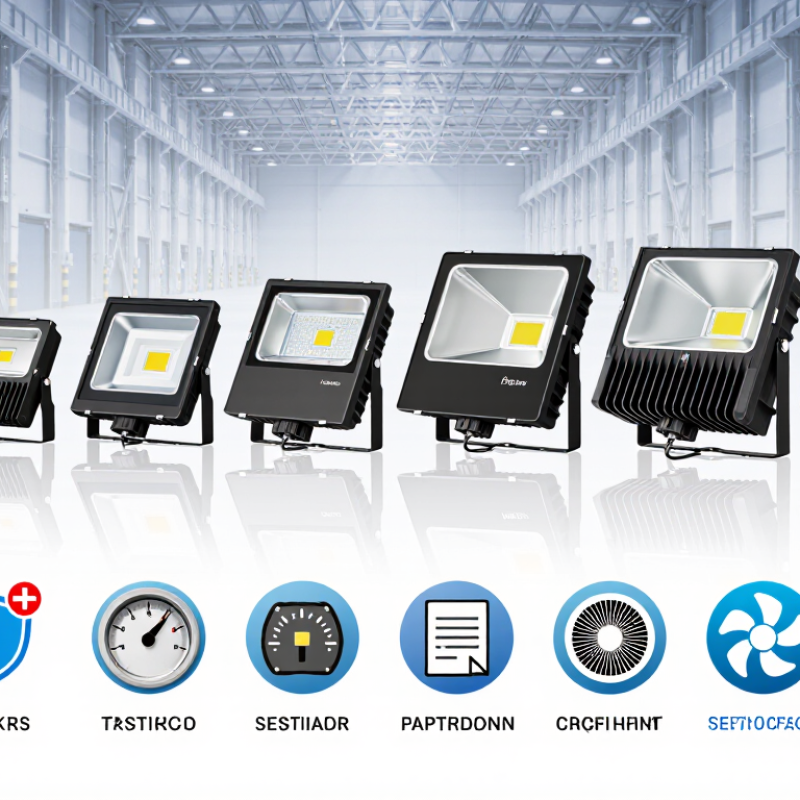
An explosion-proof LED floodlight is designed for locations where flammable gas, vapour, or combustible dust may be present. It limits the chance that an internal electrical fault ignites the surrounding atmosphere. Not just tougher lighting. Its enclosure, joints, cable entries, and operating temperature all matter. Depending on its protection method, the housing may contain an internal ignition or keep hazardous material away from ignition sources. IEC 60079-1 covers flameproof enclosures, while IEC 60079-31 addresses protection against dust ignition by enclosure.
The risk is not theoretical. The U.S. Chemical Safety Board’s 2006 Combustible Dust Hazard Study identified 281 incidents from 1980 to 2005, causing 119 deaths and 718 injuries. This history explains why a floodlight must match the site’s specific gas or dust classification, temperature class, and installation conditions. “Explosion-proof” alone is not a complete specification. Selection is rarely simple. A unit suitable for a gas hazard may not suit a dusty process area. Check its certification documents, cable glands, and temperature limits, then verify them against the site assessment. A poor match can undermine an otherwise robust fixture.
Brand-neutral guide to understanding and evaluating explosion-protected LED floodlights. The items below are technical checks, not a ranked list of manufacturers.
| No. | Evaluation dimension | Relevant fact or standard | What to verify |
|---|---|---|---|
| 1 | Meaning of explosion protection | An explosion-protected luminaire is designed and assessed for specified hazardous environments and protection requirements. A robust housing alone does not make a light explosion-proof. | Check the complete Ex marking and certificate for the exact luminaire model and configuration. |
| 2 | Applicable standards | The IEC 60079 series covers equipment for explosive atmospheres. In China, the GB/T 3836 series addresses explosive atmospheres; confirm the applicable part and edition for the product. | Look for standard numbers and editions on the certificate and technical documents, rather than relying on a general claim of compliance. |
| 3 | Protection concept | IEC 60079-1 covers flameproof enclosures (“d”); IEC 60079-7 covers increased safety (“e”); and IEC 60079-31 covers protection by enclosure for combustible dust (“t”). | Confirm that the stated protection concept is suitable for the intended gas or dust hazard and installation. |
| 4 | Gas group | Gas equipment groups commonly include IIA, IIB, and IIC. IIC is the most demanding of these gas subgroups. | Match the marked gas group to the hazardous substance classification specified for the site. |
| 5 | Dust group | Combustible-dust equipment uses dust-related markings and requirements that differ from gas equipment classifications. | Check the dust marking and certificate against the actual dust hazard; do not infer dust suitability from a gas rating. |
| 6 | Temperature class | For gas equipment, T6 indicates a maximum equipment surface temperature of 85°C under the stated conditions; T5 is 100°C, T4 is 135°C, T3 is 200°C, T2 is 300°C, and T1 is 450°C. | Ensure the marked temperature class is appropriate for the ignition temperature of the hazardous substance and the declared ambient conditions. |
| 7 | Hazardous-area zone and equipment protection level | Gas and dust areas are classified separately. Common gas zones are 0, 1, and 2; common dust zones are 20, 21, and 22. Equipment protection level markings include Ga, Gb, and Gc for gas, and Da, Db, and Dc for dust. | Confirm that the equipment protection level and zone suitability match the site’s area classification. |
| 8 | Ingress protection (IP) rating | An IP rating describes protection against solid-object and water ingress. It does not, by itself, demonstrate explosion protection. | Check the IP rating separately against the outdoor, washdown, dust, and moisture conditions at the installation site. |
| 9 | Photometric and electrical data | Lumen output, power, efficacy, beam distribution, input voltage, and power factor are product-specific values, not universal properties of explosion-protected floodlights. | Compare the datasheet values and test conditions for the exact model; confirm that beam shape and light output suit the application. |
| 10 | Certificate, accessories, and installation | Explosion-protection approval applies to the certified product design and specified conditions. Cable glands, entry arrangements, mounting, and temperature limits can affect a compliant installation. | Check certificate scope, permitted ambient temperature, approved accessories, installation instructions, and any limitations before purchase and installation. |
Note: Certification schemes and legal requirements vary by destination market. Verify current certificates and local requirements with the relevant certification body and a qualified hazardous-area professional.